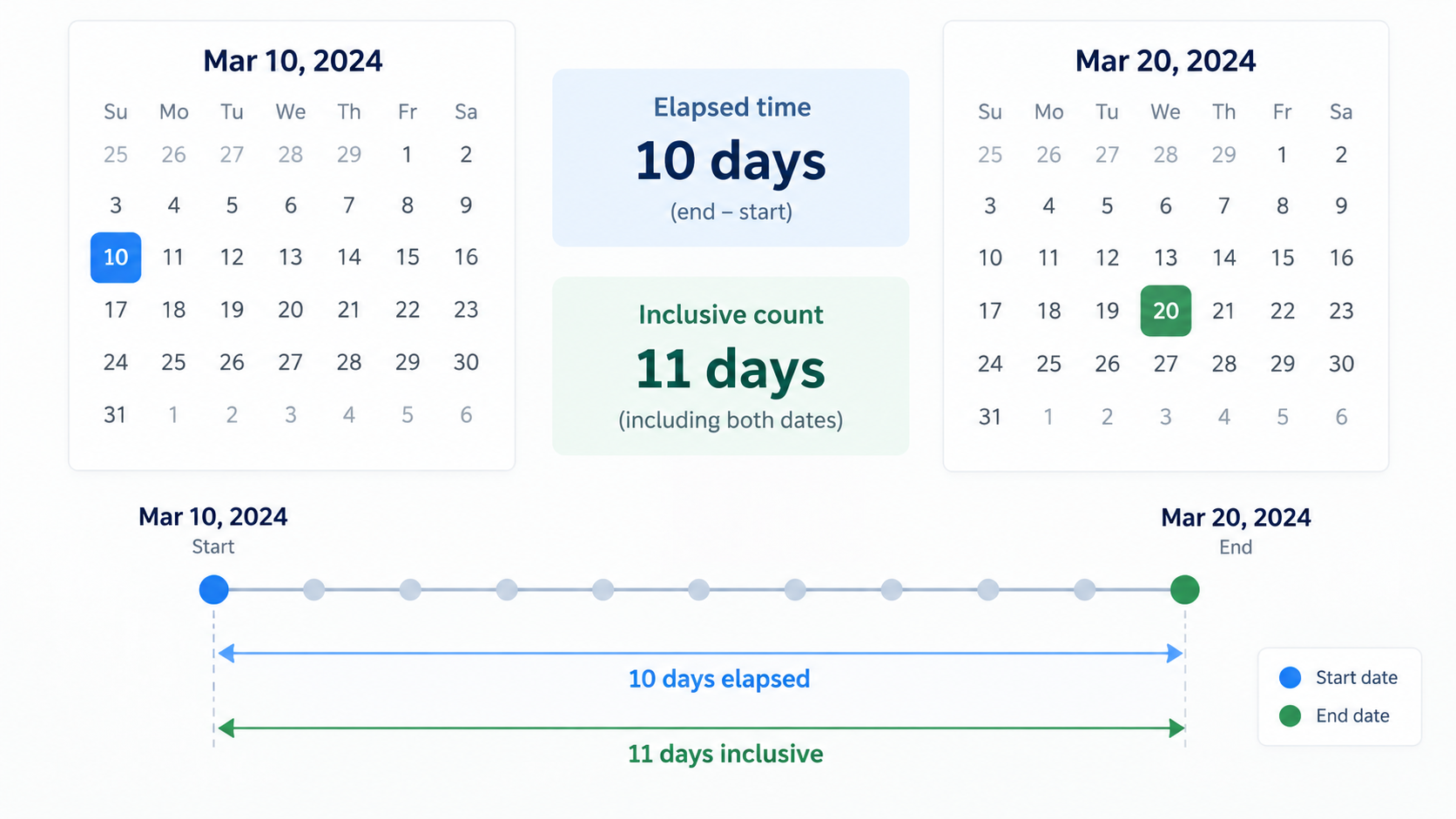
Define the question before calculating
From Monday to Tuesday is one elapsed day, but a two-day itinerary might say it includes Monday and Tuesday. Both answers can be correct because they count different things.
Elapsed time versus calendar difference
Elapsed time measures duration between instants. Calendar arithmetic compares civil dates and may express a difference in years, months, and days. Months have different lengths, so “one month” is not a fixed number of seconds.
Time zones affect instants
Two timestamps can fall on different local dates even when they are close together in elapsed time. When the inputs include times, identify their time zones before subtraction. Use Timestamp Converter to inspect the corresponding UTC instants.
Daylight-saving transitions can break 24-hour assumptions
In regions that change clocks, two occurrences of the same local clock time on consecutive calendar days can be 23 or 25 elapsed hours apart. Use calendar-aware date libraries for scheduling logic rather than adding a fixed 86,400 seconds to mean “same time tomorrow.”
Leap years matter for long spans
Date libraries handle leap days when used correctly, but hand-written year calculations often assume 365 days. Decide whether you want total days or a calendar age such as “2 years, 3 months, 4 days.”
State endpoint inclusivity
Use Date Difference and record whether the start date, end date, or both are included. This is essential for billing periods, travel nights, project schedules, legal deadlines, and SLA reporting.
FAQ
Why do hotel nights differ from inclusive calendar days?
A stay from Monday check-in to Tuesday check-out is typically one night even though two named calendar dates are involved.
Should I convert dates to timestamps first?
For elapsed instants, often yes with correct time zones. For calendar concepts such as age or monthly recurrence, use calendar-aware operations instead of reducing everything to seconds.
Practical next step
Use Date Difference after writing the counting rule in words. Most off-by-one errors come from an undefined rule, not bad subtraction.