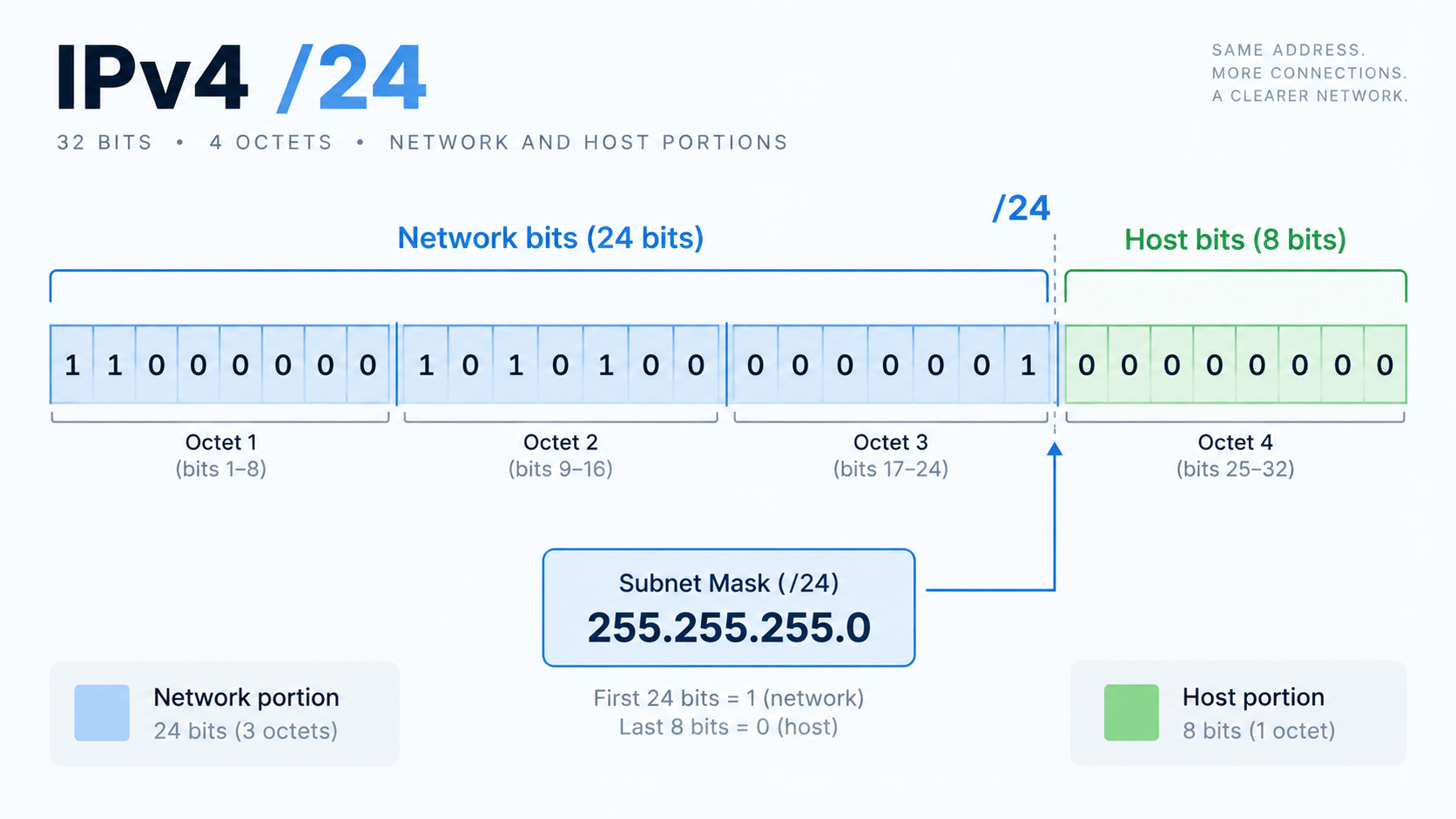
192.0.2.0/24. The number after the slash tells you how many of the 32 IPv4 bits belong to the network prefix. The remaining bits identify addresses within that block.
Read the prefix as bits
A /24 fixes 24 network bits and leaves 8 host/address bits. That creates 2^8 = 256 addresses in the block. A /16 leaves 16 bits, or 65,536 addresses. A /32 leaves zero host bits and refers to one IPv4 address.
Prefix length maps to a subnet mask
/24 corresponds to 255.255.255.0; /16 corresponds to 255.255.0.0. Use Subnet Mask Converter when you need to move between prefix length and dotted-decimal masks.
Find the network boundary
A host address such as 192.0.2.73/24 belongs to the block whose first 24 bits match, so the network boundary is 192.0.2.0/24. For non-octet prefixes such as /27, the boundary falls inside an octet and binary arithmetic becomes more helpful.
Do not blindly subtract two addresses
Traditional IPv4 subnetting often reserves the network and broadcast addresses on ordinary multi-address subnets, but special cases and point-to-point behavior exist. The safest calculation is to identify the complete address range first, then apply the rules of the network you are configuring.
Use binary to understand awkward prefixes
IPv4 Converter can show octets in binary. For /27, 27 bits are network bits and five remain, producing blocks of 32 addresses. Seeing the bit boundary makes ranges such as .0–.31, .32–.63, and .64–.95 easier to derive.
Calculate before changing network config
Use CIDR Calculator to verify network address, range, and size on lab or documentation values before applying firewall, route, or cloud-network changes. Treat the calculator as a planning aid, not a substitute for understanding the environment’s routing design.
FAQ
How many addresses are in a /24?
256 total IPv4 addresses because eight bits remain after the 24-bit prefix.
Is /32 a subnet with one host?
It denotes a single IPv4 address/prefix and is commonly used in routes and access rules that target one address.
Practical next step
Use CIDR Calculator to verify the arithmetic, especially for prefixes that do not align to whole octets.