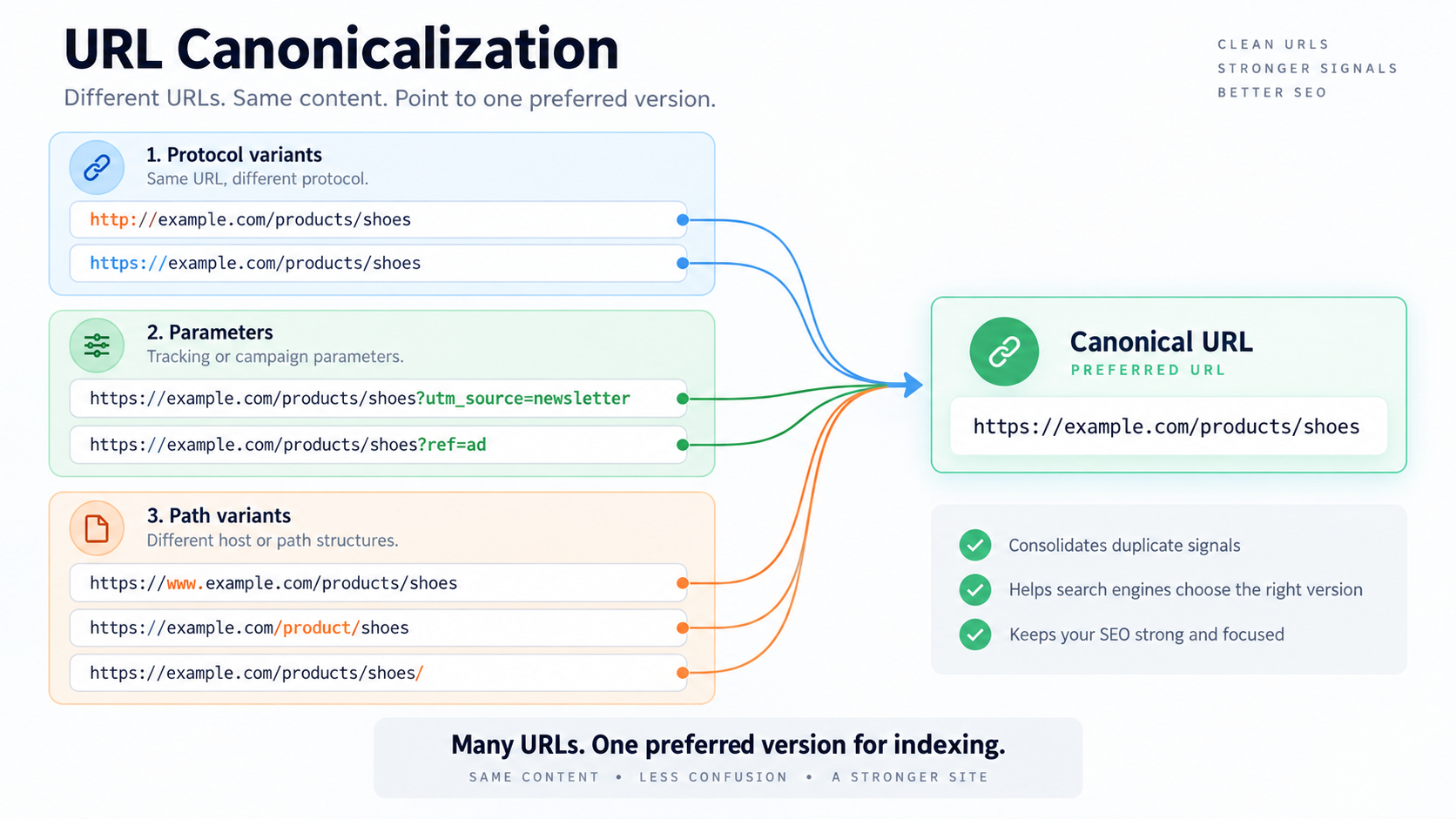
Canonicalization is the process of selecting a representative URL among duplicate or very similar pages. Google may choose a canonical itself, and site owners can provide signals such as redirects, rel="canonical", and sitemap inclusion to indicate a preference.
Use canonical when duplicates need to remain accessible
Parameter variants, print views, and similar duplicate URLs may need to exist for users while consolidating search signals to one preferred page. Add a canonical element pointing to that preferred URL with Canonical Tag Generator.
Use redirects when the old URL should go away
If a page has permanently moved and users should no longer access the old URL, a permanent server-side redirect is usually a clearer solution than leaving both pages live with only a canonical hint.
Make signals agree
Internal links, sitemap entries, redirects, canonicals, and protocol/host preferences should point toward the same URL where practical. Conflicting signals force search engines to resolve the inconsistency themselves.
Use absolute, clean destination URLs
Avoid canonical URLs with tracking parameters, session IDs, redirect hops, fragments used only for in-page navigation, or accidental HTTP/HTTPS mismatches. Parse uncertain URLs with URL Parser before generating markup.
Self-canonicals can document preference
A page can use a canonical pointing to its own preferred URL, which helps keep the intended form explicit when parameterized or alternate links exist.
Canonical is not a directive to merge unrelated pages
Do not point distinct pages to a popular page merely to “transfer SEO.” Canonicalization is intended for duplicates or sufficiently similar content; unrelated pages need their own indexing decisions.
FAQ
Does a canonical guarantee Google will choose that URL?
No. Google treats canonical signals as part of its canonicalization process and can select a different representative URL when signals or content suggest otherwise.
Should redirected URLs be in the sitemap?
Usually list the final canonical URLs you want indexed, not redirect sources.
Practical next step
Use Canonical Tag Generator for the HTML, but treat canonicalization as a site-wide consistency problem rather than a single tag.
Debug canonical disagreements systematically
When a search engine selects a different canonical than the one you declared, compare the candidate pages rather than repeatedly rewriting the tag. Check redirects, internal-link destinations, sitemap URLs, protocol/host variants, page content similarity, and whether the declared canonical itself is indexable. A canonical element is one signal inside a broader duplicate-URL system.